Web Development
 Mobile Development
 AI & ML Development
 Low-Code/No-Code Development
 React.js
 Vue.js
 Node.js
 Bubble
 Manufacturing Software Development
 Custom Real Estate Software Development
 Education Software Development
 Non-Profit Software Development
 About Us
 Team
Team Career





The lifecycle of an app does not end after its development. Actually, it only begins. In this article, we explain why software maintenance is essential, how it impacts product costs, and what practices work best for maintainers.
Practice shows that software maintenance is what makes or breaks most projects. Why? Because customer needs evolve alongside the markets. The most successful software products, such as Facebook or Adobe’s Photoshop, are constantly reinventing themselves.
For this reason, we see an increasing interest in understanding the software maintenance process. Here are some questions that we have personally encountered:
- What is software maintenance?
- What is the cost of software maintenance?
- Why do I need it in the first place?
- What types of software maintenance exist?
- How can I implement the best practices of software maintenance?
We have written this comprehensive guide on software maintenance to answer them.
Defining Software Maintenance
Let’s start with answering the first question: “What is software maintenance?”
It is the process of upgrading and modifying existing software after development. Software maintenance services usually include performance optimization, bug fixes, and development for new features:
- Companies like Nvidia, AMD, and Intel release new hardware every quarter. It often contains new instructions that need unique optimizations. Most clients update their hardware regularly to improve their productivity. If you do not update your apps, they will eventually stop working on newer devices.
- Some bugs become visible only after mass deployment. No amount of testing can take all scenarios into account. As a result, post-release maintenance is crucial for making software products more stable.
- Customers inevitably highlight some design shortcomings because they use apps in practical settings. Successful development teams build strong reputations by listening to feedback. Hence, software maintenance helps guarantee customer retention and satisfaction.
Software development is a one-time effort. It brings a product to the 1.0 release. Software maintenance is ongoing and accompanies the whole life cycle of a product.
Main Aspects of Software Maintenance
Software maintenance has several key aspects:
1) Ongoing nature. Maintenance is a continuous process. It accompanies the whole lifecycle of a product. An unmaintained product loses relevance fast due to software and hardware evolution. Compatibility problems can start appearing mere months after the end of maintenance.
2) Large scope. Maintenance involves the entire product. You need to maintain code, documentation, UI/UX, and databases. It is not enough to add new features: one needs to also describe them and adjust the interface design.
3) Focus on users. Stakeholders for maintenance are very similar to those for development. You need to consider developers, QA specialists, marketing experts, and end users in your maintenance plans. Contrary to development phases, however, end users start playing a larger role. During development, you usually have access to early adopters and focus groups. Maintenance exposes your product to the whole market. As a result, user feedback becomes even more important than before.
Key Reasons to Do Software Maintenance
One of the main advantages of software maintenance is the ability to adapt to new conditions:
Market Requirements Evolve
Markets are constantly evolving. What was enough yesterday is not enough today. For example, the short video format in the style of TikTok is now dominant. The world is moving at an increasingly fast pace, and users want similarly fast content. Facebook, Instagram, and YouTube, which focus on long-form content, have to change accordingly. Today, they offer short-form videos via Reels (Facebook and Instagram) and Shorts (YouTube).
Technologies Change
Both hardware and software are changing constantly. New processors, programming languages, and platforms are appearing every year. Moreover, this evolution is accelerating thanks to AI breakthroughs. Software (legacy) systems lose compatibility with modern hardware within months if not maintained.
New Threats Arise
Cybersecurity threats are also evolving daily. Criminals exploit new security vulnerabilities, using bugs or UI/UX shortcomings for their attacks. Bugs like Heartbleed in OpenSSL allow attackers to steal passwords and private keys if not fixed. Unpatched software without vital security updates is usually the main target of these attacks. As a result, software maintenance is the cornerstone of software security because it removes vulnerabilities.
User Numbers Grow
Developers usually adapt 1.0 releases to predictions made by market analysts. For example, they can at first target 10000 daily users. This obviously leads to technical limitations if an app becomes more popular. Regular optimizations become essential for growing a loyal user base. Hardware and software changes also require active optimizations.
Regulations Change
Governments across the world actively introduce new laws for IT. Regulations like GDPR and HIPAA often necessitate big software changes. These changes are not arbitrary: they protect consumers from various emerging threats. So, if your app does not comply with these laws, you risk fines and reputational damage.
Technical Debt Accumulates
No developer team is perfect. Neither are modern coding AIs. As a result, even the most well-tested apps have some bugs post-release. Some can frustrate the users; others can affect security. Software maintenance is essential for improving user experience and app security. Moreover, it prevents technical debt, which happens when bugs accumulate for a long time.
Product Scopes Change
Many products are released with rather modest feature sets. Markets force them to change, and such change can completely transform those apps. Firstly, growing user bases require better software infrastructure to ensure stability. Secondly, new features are often necessary to adapt to their feedback. YouTube started as a platform for long-form videos, but now offers short videos and a separate music app, too. Instagram transformed from a location check-in app to a photo-sharing platform.
Key Challenges Faced by Maintenance Engineers
We can list several challenges faced by maintenance engineers based on industry experience:
- Lack of documentation. Often, legacy code has no good documentation because nobody wrote it, or it was lost. So, maintainers have to do reverse engineering to refactor it.
- Technical debt accumulated during rapid development. Rapid development is often a must in modern, often volatile markets. The faster one captures a market niche, the better. However, it leads to low-quality code and problems with documentation.
- Balance between new features and optimization/bug fixes. If you overfocus on fixing bugs, your app can fall behind competitors’ features. If you concentrate on new features too much, technical debt will increase.
- High cost and resource allocation challenges. App maintenance is not cheap. You need to consider this before beginning development. Decision-makers who ignore maintenance can later face unexpected costs.
- Risk of introducing new bugs when modifying existing code. Every change to app code can lead to new problems. This means that you need to have an experienced team of testers to ensure smooth software updates.
- Adaptation to evolving dependencies. Most software architectures depend on third-party libraries, which are actively developed. Their maintainers often change some associated commands or remove legacy features. As a result, you may need to periodically rewrite a lot of code to adapt to those changes in the environment.
Key Software Maintenance Types Procedures
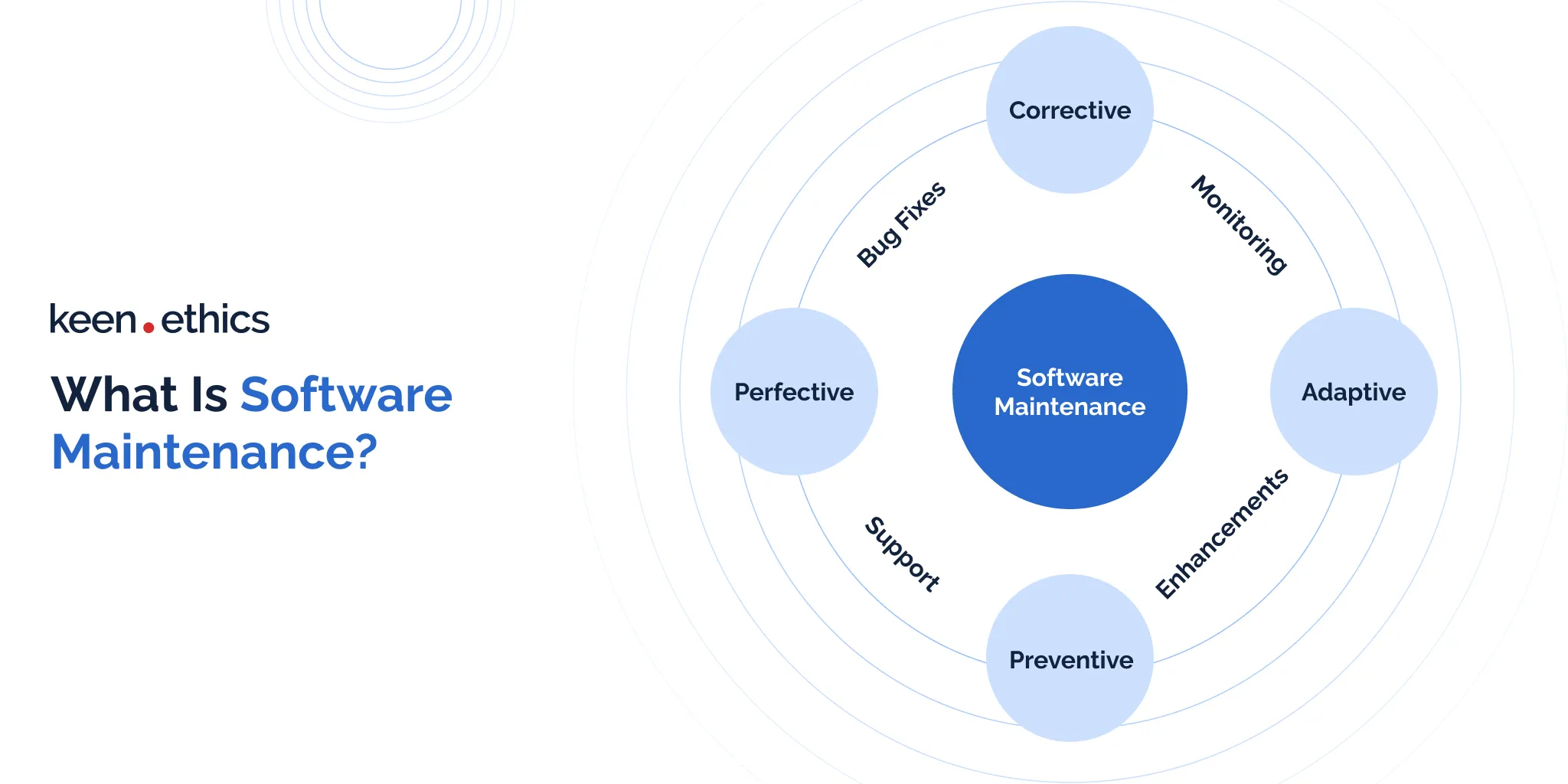
Software quality usually depends on these four types of maintenance:
1. Corrective Maintenance
This type of maintenance is about fixing bugs discovered after the release. It is reactive: if something breaks, then maintainers fix it. Developers usually make changes based on user reports, post-release testing, or system failures.
2. Preventive Maintenance
This approach is proactive: maintainers are actively looking for potential issues. They achieve this via stress testing, code refactoring, and updates aimed at new hardware/software. Preventive software maintenance increases cost efficiency by preventing issues before they occur.
3. Perfective Maintenance
This type of maintenance is about enhancing existing and adding new features. Developers usually do it based on user feedback and evolving market demands. Perfective software maintenance is vital for improving usability and growing customer loyalty. Alongside preventive maintenance, it ensures product longevity. You can either add new features directly into your app or deliver additional modules, so-called extended software.
4. Adaptive Maintenance
The hardware and software environments necessary for running all apps are evolving constantly. Adaptive software maintenance helps ensure compatibility with new computer chips and software frameworks. Typical examples include migrations from one OS to another or a transition into the cloud. By mastering software maintenance of this kind, companies like Microsoft and Adobe have stayed relevant for decades.
Key Processes in Software Maintenance

Based on our experience, you need to consider the following steps:
1. Find Issues & Track Them
At this stage, you need to register issues and change requests given by stakeholders. The best practice is to add them to a tracking system like Trello or Jira. This approach helps assign priorities to issues and ensures they are not forgotten. Proper tracking is the cornerstone of maintainability.
2. Categorize and Prioritize Issues
You need to create a system of priorities for various tasks. Assess them based on urgency, impact, and complexity to then create a schedule for fixes.
3. Design a Plan for Solving a Particular Issue
Once you have selected a particular issue, you need to plan how to remove it. You should split the plan into steps, describe the resources needed for solving the issue, and assign a deadline.
4. Implement Changes
After splitting the problem into clear steps, transfer it to your developers. Their goal is to implement changes based on your current coding standards.
5. Test the New Changes
QA specialists should review changes after their implementation. This is usually done on the testing branch of your software. Your testers can do automated and/or manual unit, integration, and regression tests to ensure everything works well.
6. Ask Users to Offer Feedback
One of the best practices for maintenance is to let users offer their feedback on changes. You can offer them a preview version for personal testing. Firstly, user feedback can indicate some additional bugs that need fixing. Secondly, they can assess if new features actually solve targeted user pains or need more work.
7. Deployment to Production
Once testing is done and your users approve of the changes, deploy the changes to production. Ask your developers and QA experts to review if everything works as intended one more time.
8. Post-Deployment Analysis
The last step is to monitor how changes perform after deployment. Here, you should record what changed and what remained static. It is crucial to continue collecting feedback to remove any new bugs. Your team should also properly close tickets in tracking systems to ensure transparency.
Which Software Maintenance Approaches Are Currently in Use?
Modern technologies enable multiple approaches to software maintenance:
1. AI-Centric (NoOps) Maintenance
Modern AI platforms help automate many maintenance tasks. Platforms like Dynatrace and Datadog can monitor apps to predict their future performance. Red Hat’s Ansible Automation Platform automates patch management. Moreover, the rise of AI coding tools allows developers to go even further. They can change code to fix bugs, allowing developers to focus more on new features. These AI platforms, of course, still require human supervision, but they mostly eliminate the need for manual bug fixes.
2. Security-Oriented Maintenance
This type of regular maintenance approach focuses on three aspects: monitoring, testing, and patching. Developers need to review security news to identify if new issues affect their code. Moreover, they must proactively test whether their platform can withstand attacks (penetration testing). The last step is to introduce fixes and ensure all users receive security patches on time. Some of the most powerful tools in this space include Snyk, Qualys, and Nessus.
3. Cloud-Based Maintenance
Platforms like Kubernetes and Docker enable users to manage their products on the Internet, giving them access to a vast cloud infrastructure. This infrastructure offers many powerful tools for maintenance. The most popular platforms for easing maintenance in this space are Amazon Web Services, Azure, and Google Cloud. They offer built-in programs for regular software maintenance and have instruments for auto-scaling.
What Are the Best Practices for High-Quality Software Maintenance?
Our experience shows that the following actions are essential:
- Maintain detailed documentation, modifying and updating it regularly. This approach can simplify code refactoring for future maintenance teams.
- Use apps for automated version control, such as Git, to prevent chaos in change tracking.
- Do manual and automated testing to find whether new changes affect older functions.
- Introduce a framework for assessing problem urgency and severity. One of the most powerful approaches we can recommend here is the Eisenhower Matrix.
- Adopt task management apps like Trello or Jira to ensure comprehensive issue tracking.
- Perform regular code reviews to ensure timely refactoring.
- Establish a procedure for responding to critical bugs. Create a system for version rollbacks and a problem-solving procedure for urgent situations.
Tools and Technologies for Software Maintenance
Multiple tools can help you with software maintenance. Here is a list of them according to their functions:
- Version control: Git (GitHub, GitLab)
- Task/issue management: Jira, Trello, ClickUp
- CI/CD tools: Jenkins, GitHub Actions, GitLab CI/CD, Azure DevOps
- Monitoring instruments: Datadog, Dynatrace, Red Hat Ansible Automation Platform
- Security scanning: Snyk, Nessus, Qualys, Veracode
How Much Does Software Maintenance Cost?
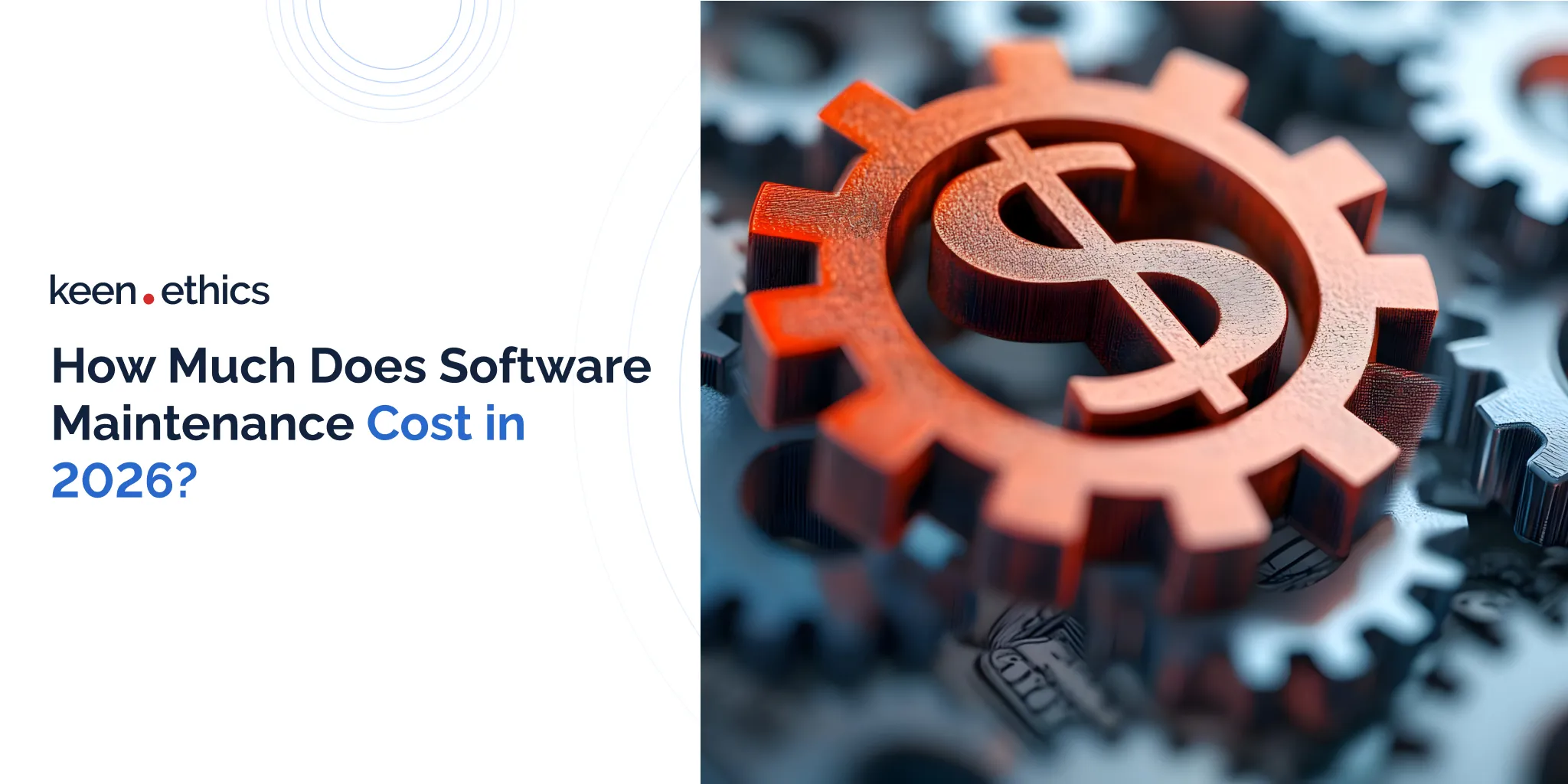
Software maintenance usually consumes more than 50% of the software lifecycle cost. A successful app needs to evolve, or competitors will outpace it. One-time releases are usually not enough. That’s why all major players like Google, Microsoft, and Amazon constantly update their apps.
The final cost of software ownership usually depends on multiple factors. Team size, code complexity, the pace of market evolution, and user base scope can all affect it. Forms of maintenance also have a major impact: some are cheaper than others.
Corrective maintenance is usually the most expensive. It is reactive and usually takes place after problems have already manifested. Bugs can disrupt dependent platforms and affect thousands of users. Cloudflare outages in November 2025 and February 2026 disabled multiple large-scale sites like X and ChatGPT for hours. These examples show that corrective maintenance is not enough: you need to be more proactive.
Preventive maintenance allows companies to do just that. By improving codebases and finding problems before they affect users, you can reduce costs. This approach is especially attractive now thanks to the rise of AI automation tools. In the past, predictive maintenance required large teams dedicated to finding potential issues. Now, even relatively small teams can expand the lifespans of software products.
Conclusion
All in all, software maintenance is at least as important as software engineering. Customers create new demands. Software and hardware introduce new development standards. To remain relevant, you have to ensure consistent updates for your app. Even a 6-month pause in maintenance can render your software product unusable. As a result, our main recommendation for maintenance is to be proactive. It is not enough to correct issues when they arise: you have to find them before they do damage. Moreover, the cost of predictive maintenance is falling thanks to automation tools, AI, and task management apps. So, effective maintenance practices are no longer paywalled and can be adopted by everyone. Complex software systems need active maintenance: the earlier you start it, the better.
Keenethics has been delivering software maintenance services for more than 10 years. We can help you analyze and improve maintenance processes, update your software in accordance with industry standards, and perform security audits.