Web Development
 Mobile Development
 AI & ML Development
 Low-Code/No-Code Development
 React.js
 Vue.js
 Node.js
 Bubble
 Manufacturing Software Development
 Custom Real Estate Software Development
 Education Software Development
 Non-Profit Software Development
 About Us
 Team
Team Career





Once you step closer to launching a SaaS product, the excitement starts to build up. It’s tempting to finally show users what you’ve been working on, and even more tempting to skip a few steps to get there faster. But with so many moving parts to manage at once, a solid SaaS product launch checklist is what keeps everything on track.
At Keenethics, we’ve worked on numerous web and mobile development projects and supported products through successful launches. Based on that experience, we’ve put together this guide to help you approach the same process with more clarity and control. But before we get into the details, let’s start with the basics.
What is a Product Launch Checklist?
A product launch checklist is a structured plan that outlines everything you need to prepare, execute, and follow up on when bringing a product to market. It helps you move through manageable steps, so nothing important gets missed along the way.
In SaaS, where product, marketing, and business decisions are tightly connected, this kind of structure matters even more. You’re introducing a solution that needs to resonate with a specific audience, perform reliably from day one, and support future growth. A checklist keeps all of these elements tied together.
Without one, teams often run into the same set of problems:
- Work becomes reactive rather than planned.
- Priorities shift too frequently, pulling focus in different directions.
- Critical tasks fall through the cracks.
- Products go live without clear positioning.
- The wrong audience gets attracted.
- Technical issues impact the early user experience.
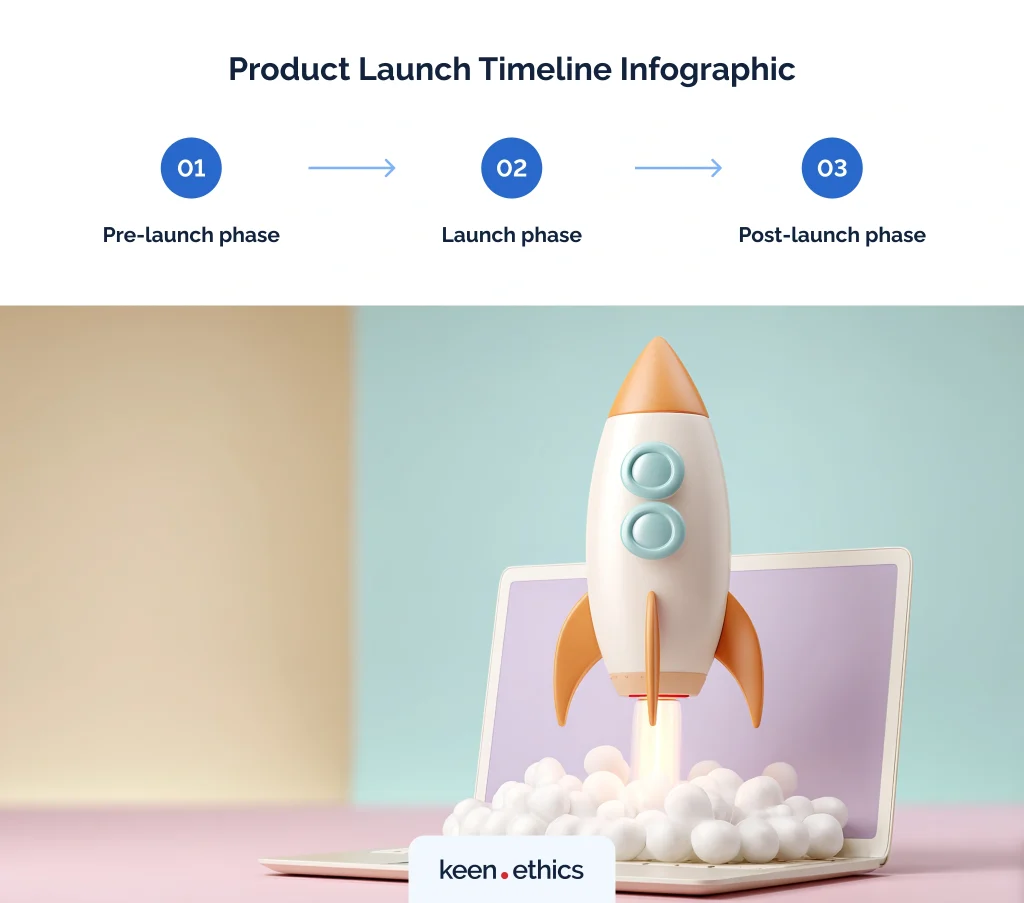
In fact, a product launch checklist covers three main phases — pre-launch preparation, launch execution, and post-launch growth. Each of them includes a range of tasks that need to be handled carefully, and that’s exactly what we’ll walk through next.
Pre-Launch Phase
That’s where it all starts. During the pre-launch phase, you gather the information needed to confirm that your idea solves user problems. It’s the moment to conduct the research, test assumptions, and make sure you’re building something meaningful.
Conduct Market Research
Before writing a single line of code, you need to understand the space you’re entering. It may seem like an unnecessary step, but in practice, teams that skip or rush research often end up launching solutions that are technically solid but land flat, simply because no one validated whether the market wanted them in the first place.
A good starting point is analyzing your competitors. Look at their pricing, customer reviews on platforms like G2 or Capterra, and the complaints users keep raising. This gives you a picture of how fast others are innovating, where they are focusing, and which segments remain unaddressed. That’s where your opportunity lies.
Identify Target Audience and Personas
With market research in place, the next step is getting specific about who you’re building for. One of the most common mistakes we see is trying to appeal to everyone and, as a result, resonating with no one. By the time teams realize this, they’re already deep into product development or close to launch, and changing direction becomes much harder.
User personas help you avoid that trap early on. While there are many templates you can use, the key is to capture your users’ goals, frustrations, decision-making habits, and what their typical workday looks like. These differences matter, and your messaging, pricing model, and onboarding should reflect them.
To build personas that are actually useful, you can:
- Conduct interviews with 10-15 people who match your target profile.
- Analyze behavioral data if you already have a product or waitlist.
- Review discussions in communities like Reddit, Slack groups, or niche forums.
- Study customer reviews of competing products.
Define Your Unique Selling Proposition
Having a clear view of what’s already out there and where the gaps are helps you shape your Unique Selling Proposition (USP). It’s a statement that explains why someone should choose your product over everything else available to them.
A weak USP often sounds like “we’re faster, easier, and more affordable,” which tells users almost nothing. The strongest SaaS value propositions are concise, benefit-driven, and outcome-oriented, focusing on the result the user gets.
To define your USP, go back to what you learned during market research. What frustrations kept coming up in your user interviews? What are competitors consistently getting wrong? Negative reviews from your product and your competitors are the most honest source of insight, because they tell you exactly what users wish existed.
Build a Minimum Viable Product
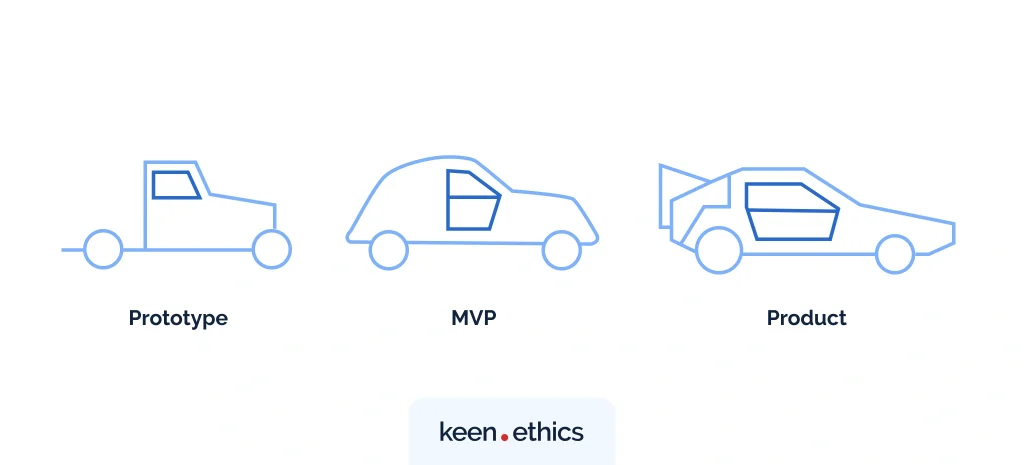
You’ve come to the building part. At this stage, MVP development allows you to create the simplest version of your product that still delivers real value. By putting it in front of users, you can test your core assumptions before full-scale development.
You don’t always need a fully functional product to start learning. Dropbox, for example, validated its concept with a simple three-minute explainer video, growing its beta tester list from 5,000 to 75,000 before writing a single line of code.
When defining your MVP, focus on the essentials:
- Prioritize 3–5 features that directly solve the core problem.
- Cut anything that doesn’t contribute to that core value.
- Get your MVP in front of real users as early as possible.
Once users start interacting with your product, you can observe how it performs in real conditions, what works, what feels confusing, and what’s missing.
Define Pricing and Go-to-Market Strategy
Pricing is one of the decisions that directly shapes how your product is perceived and how quickly you can grow. From our perspective, the best starting point is asking: how does your customer actually get value from the product? Based on the answer, you can determine whether a usage-based, per-seat, or tiered model is the best fit.
Your go-to-market strategy is the other side of this coin. It defines how you reach your audience, what channels you prioritize, and how marketing and sales work together to drive early traction. To make it effective, focus on where your users spend their time and prepare the right website and marketing assets to meet them there at the right moment.
Set Key Performance Indicators and Milestones
One of the most valuable lessons we’ve learned is to define success metrics and set clear milestones before the product goes live. With them in place, you can track how your launch is performing and quickly spot where things might be going off track.
For a SaaS product launch, the metrics that tend to matter most early on are:
- Signups and activation rate.
- Customer Acquisition Cost (CAC).
- Monthly Recurring Revenue (MRR).
- Churn rate.
Beyond the metrics themselves, set concrete milestones with dates attached. This could mean reaching 100 active users in the first month or hitting a specific MRR target by the end of quarter one. Clear targets give your team a direction to move forward.
Launch Phase
After all the preparation, the launch date is the moment when everything finally comes together. It’s also when things start moving fast. You’ll need to keep a close eye on the process and stay responsive so you don’t miss anything important.
Announce the Product Launch
The launch announcement is a moment you’ve likely been waiting for. To make it effective, focus on consistency across channels. Your email list, social media, press outreach, and any communities you’ve built during the pre-launch phase should all go live with the same core message at the same time. For B2B SaaS in particular, launching on Product Hunt can be a powerful way to attract early adopters, while direct outreach on LinkedIn often performs better than broad advertising.
Engage Early Adopters
Once the launch comes, make early users feel heard. Reach out personally where possible, respond to customer feedback, and be transparent about your roadmap. Focus on whether your product is intuitive, whether it’s solving the right pain points you identified, and whether there are any bugs or friction points. Teams that invest in these relationships early see compounding benefits for months after launch.
Ensure Effective User Onboarding
To avoid losing users in the first few days, pay attention to your onboarding flow. If users don’t understand how your product works, they’re unlikely to stick around, even if your marketing is strong and your product offers powerful features. Helping them reach value quickly is one of the most important goals during the launch phase.
For this, you can:
- Add a short product demo.
- Offer a guided walkthrough.
- Use in-app tutorials or tooltips.
- Provide emails with onboarding steps.
Product analytics tools can support this process by showing how users interact with your product and where friction occurs, so you can improve the experience.
Monitor Technical Performance
Launch day brings a different kind of pressure on your infrastructure. Traffic spikes, edge cases, and real-world usage patterns often reveal issues that never showed up during beta testing. How quickly you respond to them directly shapes how early users perceive your product’s reliability.
In your SaaS launch checklist, include monitoring for:
- Server response times.
- Error rates.
- Uptime.
- Database performance.
Set up real-time tracking so any critical bugs or downtime can be addressed immediately. It’s also worth assigning a dedicated person on launch day whose only job is watching the dashboards. All in all, the cost of missing an early issue is always higher than the cost of catching it quickly.
Provide Ongoing Customer Support
Your first users will have questions and feedback, so have your entire customer support team ready to respond to tickets, social media, and emails. Even if your support setup is still lightweight in the first weeks, what matters is responsiveness and transparency. Users who run into problems and get a fast response tend to become loyal customers. Those who feel ignored or dismissed rarely stick around, and they say so publicly.

Post-Launch Phase
By this point, you can take a breath, as the main part of the work is already done. But it’s not over yet. Once your product is live and users interact with it, you move into the post-launch phase to learn, improve, and build momentum.
Collect and Analyze User Feedback
Once users are actively engaging with your product, feedback becomes one of your most valuable assets. The key is to treat it as a continuous input.
In practice, a mix of methods works better than relying on any one channel:
- In-app surveys gather feedback while the experience is still fresh.
- NPS and CSAT track satisfaction over time.
- Support tickets and live chat reveal friction points.
- Communities like Reddit or Slack surface candid opinions.
Collecting feedback is only half the job. The real value comes from combining qualitative insights with quantitative data. If users report confusion around a feature and your analytics show low engagement, you can confidently prioritize improvements.
The last step, and the one teams most often skip, is closing the loop. Let users know their feedback has been heard and acted on. Even a small message saying “you asked, we built it” can make a meaningful difference to user loyalty.
Track Product and Business Metrics
At this stage, you return to the metrics you defined during the pre-launch phase and evaluate whether your growth is real or only looks good on the surface. One area worth watching closely is feature adoption. A feature might show strong overall usage but low uptake among your highest-value customers, which can signal a positioning issue or a mismatch with their core needs. Conversely, a feature you considered minor might turn out to be closely tied to long-term retention.
Iterate on Product and Positioning
Your early users will reveal things no amount of pre-launch research could predict. Some features will be used in unexpected ways, while others will go untouched. Even the way users describe the problem your product solves is often sharper than anything your original positioning doc contained. Pay attention to how people explain your product to others, as it often points to more resonant messaging than you have.
To refine positioning, run experiments with messaging, creative assets, and funnel flows, and use insights from sales and customer success teams. These small adjustments can compound over time and have a measurable impact on conversion and retention. On the product side, look for patterns that come up repeatedly, across different user segments, and prioritize them.
Scale Marketing and Growth Efforts
When users are staying, metrics are trending in the right direction, and you have a clear picture of who your best customers are, that’s the signal to start scaling. This usually means investing more in marketing channels that are already generating your best customers, and pulling back from those that haven’t. Sustaining content marketing efforts, building community around your product, and expanding through partnerships all help maintain momentum and position your brand as an authority in the space.
Top Tips for Your SaaS Product Launch
As you can see, there are many moving parts that go into a successful SaaS product launch and beyond. With that in mind, we want to share a few tips based on patterns we’ve seen across different products that can help you stay focused.
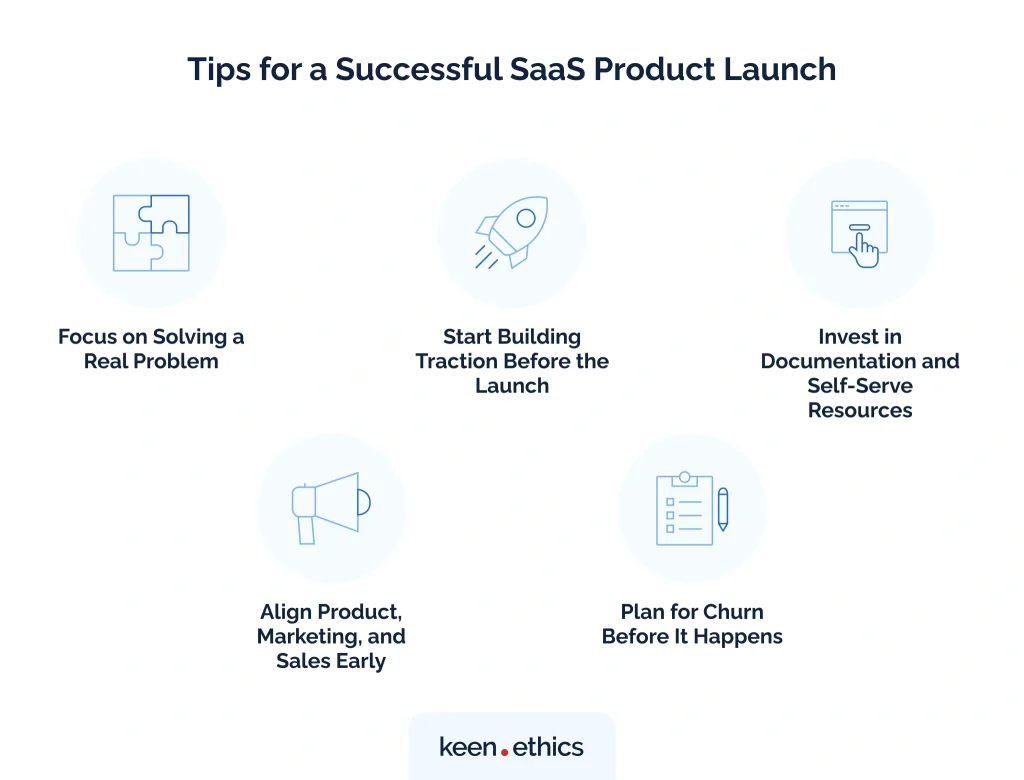
1. Focus on Solving a Real Problem
It sounds obvious, but too many MVPs end up overloaded with features nobody really asked for. Your product should solve one real pain, clearly and fast, not be everything to everyone. From the start, make sure you can answer one simple question: what specific problem does this product solve, and for whom?
2. Start Building Traction Before the Launch
Your launch day shouldn’t be the first time anyone hears about your product. The teams that gain traction early are usually the ones that started building awareness weeks or even months in advance. Create a waitlist, share behind-the-scenes updates, and engage in communities where your target users are already active.
3. Invest in Documentation and Self-Serve Resources
No matter how intuitive your product is, users will have questions, and how easily they can find answers on their own directly affects whether they stick around. A knowledge base, FAQ page, or even a handful of well-written how-to guides can reduce support load significantly while making users feel more confident.
4. Align Product, Marketing, and Sales Early
Different teams contribute to a product’s success, and to reach the desired outcome, all of them need to work in sync. Product, sales, and marketing teams each have their own responsibilities, but they all feed into the same result, and getting everyone on the same page early is what prevents costly misalignment down the line.
5. Plan for Churn Before It Happens
Most teams start thinking about retention after users start leaving, but by then, you’ve already lost valuable early adopters. A basic retention strategy should be part of your product launch plan. Even simple things like a well-timed check-in email or an in-app prompt when a user goes quiet can make a meaningful difference in the first weeks.
Final Checkpoint
When you go through your own SaaS product launch, you’ll see that it rarely follows a straight line. Features ship later than planned, some things simply won’t go the way you expected, and that’s completely normal. What matters is staying grounded in the process and keeping focus on what you can control.
And when the pressure gets too high, or you simply don’t have the bandwidth to do it all on your own, Keenethics is here to help. We’ve worked with teams at different stages of the journey, and we know what it takes to build a product users actually want to come back to. Let’s make that happen together.
Keenethics has helped teams bring SaaS products to market for over 10 years. We can guide you through every stage, from pre-launch preparation and launch day to post-launch stability, so nothing falls through the cracks.

FAQ
What is the key to a successful product launch?
The most important factor is preparation that starts well before your initial launch date. You need to deeply understand your target audience, have a clear USP, and make sure your product and marketing are fully aligned before you go live. Beyond that, it comes down to being responsive to user feedback, to performance data, and to the signals your market is sending you in those first critical weeks.
How far in advance should you start preparing for a product launch?
For most SaaS companies, serious preparation should begin at least three to six months before launch. This gives you enough time to conduct proper market research, build and test your MVP, develop your marketing strategy, and create the assets your team needs to execute well on launch day. The earlier you start, the more room you have to course-correct without the pressure of a looming deadline.
How do you know if your product is ready for launch?
Product readiness means having a solution that solves the core problem for your target market. A good signal is when your beta users are getting consistent value from it, your critical bugs are resolved, and your onboarding gets new users to that first “aha moment” without hand-holding. If those boxes are ticked, you’re ready enough to launch and let real-world usage guide what comes next.
What is a product checklist?
A SaaS launch checklist is a structured plan that covers every task your team needs to complete before, during, and after launch. It keeps your SaaS business on track by making sure nothing important gets missed.
What are the minimum viable features for a SaaS launch?
This depends on your product, but the principle is consistent: launch with the features that directly solve your core problem, and nothing more. At a minimum, your product should have a working onboarding flow, the one or two features that deliver your primary value, basic account management, and reliable performance under real user load. Everything else can come after you’ve validated that the core experience works.
What post-launch metrics should I track?
The metrics that matter most in the early stages are activation rate, churn rate, monthly recurring revenue, and customer acquisition cost. Together, these tell you whether users are finding value quickly, whether they’re staying, and whether your sales efforts are sustainable. As your business matures, you can layer in more nuanced metrics, but these four give you the clearest picture of how your launch is performing.
What are the most common SaaS launch mistakes?
The mistakes we see most often come down to a few recurring patterns: launching without taking time to learn your target audience, failing to differentiate your product clearly enough in a crowded market, and treating the launch as a one-time event. Many companies also underestimate how much support early users need, or choose a freemium model without a clear path to converting free users into paying customers.