Web Development
 Mobile Development
 AI & ML Development
 Low-Code/No-Code Development
 React.js
 Vue.js
 Node.js
 Bubble
 Manufacturing Software Development
 Custom Real Estate Software Development
 Education Software Development
 Non-Profit Software Development
 About Us
 Team
Team Career





How much does software maintenance cost? What affects these costs? If you want answers to these questions, you have found the right article!
Software maintenance is as important as development. It helps remove bugs and improves user experiences. But it is not enough for firms to know that something is vital: costs matter as much. In this article, we discuss the average cost of software maintenance, factors that affect it, and the practices that optimize it.
Software Maintenance Costs: A Definition
Let’s start by defining what software maintenance costs are. To do this, we first need a definition of software maintenance. It is the process of upgrading and modifying existing software after development. Maintenance is necessary during the entire lifecycle of a product. Markets and technologies are constantly changing, requiring software to adapt accordingly.
So, the cost of software maintenance is the sum of all resources necessary for maintenance over the entire lifecycle of a product. There are two components to these costs: labor and supporting resources. Firstly, you need a team of maintainers to spend their time supporting a product. Secondly, this team will need additional resources to do maintenance well. Typical supporting resources are hardware, software, and market data. Experts indicate that software maintenance often amounts to more than 50% of total lifecycle costs.
Existing Types of Software Maintenance

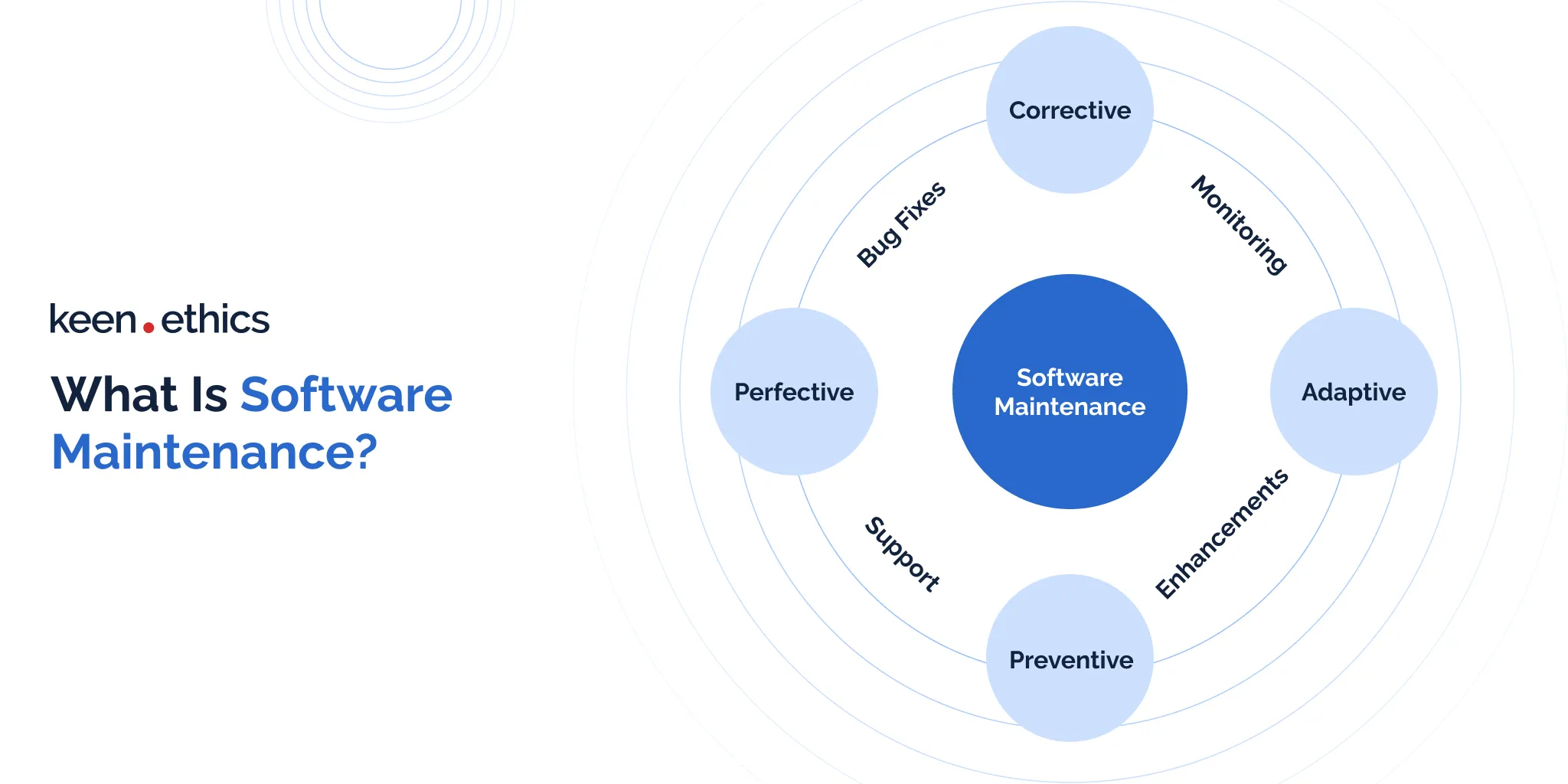
Corrective Maintenance
This type of maintenance is usually reactive. When a product encounters some issues, maintainers solve them. For example, if a site goes down, developers and testers search for fixes. Corrective maintenance is inevitable because no amount of testing can predict all errors. However, it also affects the cost of software maintenance the most. An error that is fixed after appearing can prevent clients from using your app. As a result, this can lead to financial losses for everyone. The less you rely on corrective maintenance, the lower your software maintenance costs are.
Adaptive Maintenance
Software and hardware are constantly evolving. Libraries used in projects receive new features and security fixes. Recently released hardware comes with new instructions. All this necessitates periodic software updates. They enable developers to add new features, remove security vulnerabilities, and ensure compatibility. Unmaintained software is open to various threats and is unlikely to work on modern operating systems. Even 6 months without maintenance can render an app unusable. As a result, no project can survive without constant input from maintainers.
Perfective Maintenance
Many people believe that maintenance is only about supporting an app. However, it also includes the development of new features. The 1.0 release usually delivers the key features of a software product. Usage data can quickly reveal that they aren’t sufficient. Firstly, some features can be generally good but have some drawbacks. Secondly, users can highlight that they need some additional functions. All this requires additional development aimed at perfecting your app. This process is different from 1.0 development because it does not transform your software. It merely adds new functions to it. This type of maintenance is also very important for reducing software maintenance costs. Why? Because it compensates these costs by improving user satisfaction and retention.
Preventive Maintenance
The best way to solve any problem is to remove it before it becomes big. Preventive maintenance does just this. It requires maintainers to anticipate bugs and fix them before they cause damage. The best practices here include pre-mortem analysis, stress testing, and code refactoring. This type of maintenance is essential for decreasing software maintenance costs. Errors and bugs are inevitable in all products. However, their financial impact can be relatively small if you fix them on time.
What Affects Software Maintenance Costs?

Two types of conditions can affect the cost of software maintenance:
Information Technology (IT) Factors
Key factors affecting maintenance costs come from the IT sector itself. Software systems and hardware are constantly evolving to overcome threats and offer better functions. Developers create new libraries and platforms; companies like Intel release new chips. All this means that every app is exposed to a very dynamic environment. New libraries can remove potential threats to businesses and simplify development and maintenance. New hardware improves software performance but requires patches for compatibility. As a result, maintenance is an unavoidable need because all software is a part of this evolving space. An app that doesn’t evolve is quickly going to become obsolete.
Non-IT (Outside) Factors
Outside factors are much more diverse. Firstly, maintainers should consider user feedback. A maintenance team that ignores user input will inevitably lose its audience. Since user needs are not static, this factor also makes maintenance essential.
Secondly, competitors always try to capture new markets. This means that the markets will produce new software solutions aimed at replacing yours. Maintenance is important if you want to defend against competitors. Continuous updates can perfect your app and adapt it to new standards.
So, market forces also turn software maintenance into a must. These software maintenance cost factors make perfective approaches especially important. A product must evolve not only technologically but also functionally.
Why Best Practices Are Vital for Reducing Software Maintenance Costs
The best way to reduce the cost of software maintenance is to follow the best practices. If your procedures are worse than those of the competitors, you will face unnecessary losses. Over the years, IT maintainers have developed multiple rules of good maintenance. These rules can be learned independently by reviewing textbooks and Internet guides. However, since this method is time-consuming, a better choice is to consult experts. Keenethics offers software support and maintenance services, so feel free to contact us.
Our experience shows that several practices have become universal. They are guaranteed to decrease software maintenance costs if used correctly:
- Documentation is vital. You need to regularly modify and update it. Future maintenance teams will thank you for clearly describing how all functions work. This information will be very important for avoiding issues during refactoring.
- Version control simplifies management. Services based on Git (GitHub and GitLab) remove the need to manually control versions. This technology saves a lot of labor by making development transparent.
- Thorough testing is a must. Always do thorough manual and automated tests after releasing new versions of your product. Bug fixes can sometimes introduce new bugs. As a result, all maintenance changes need to be double-checked. Attempts to save on testing inevitably lead to the accumulation of software errors. They can eventually require a complete and urgent refactoring.
- Proper task and issue management reduces costs a lot. Use management tools like Trello, Jira, or ClickUp to track various tasks and issues. If tracking is not unified, your maintainers can do a lot of redundant work or lose sight of critical issues. Using apps is not enough, however. You need to also properly prioritize issues based on urgency and importance. We believe that the best approach for prioritization today is the Eisenhower Matrix.
- Regular code reviews prevent major problems in the future. You need to also regularly review your code base to see whether there are any emerging problems. Code reviews are usually done by programmers. Cooperation with testing teams is essential here. Tests can reveal that something is wrong with some code fragments in the first place.
- Emergency protocols reduce the damage of unexpected errors. All products eventually face critical errors that disrupt them. If you don’t have a procedure for reacting to them decisively, damage from them can increase. Chaotic responses to crises greatly raise software maintenance costs.
Why Is Software Maintenance So Important for Businesses?

There are many reasons why software maintenance is vital for business. Investing in a software maintenance service is, in fact, as important as investing in development. Let’s review those reasons in detail:
Improving Security
Security threats are constantly evolving. Since all software has bugs, attackers eventually find ways to exploit them. An unmaintained app will quickly accumulate multiple bugs of this type. For this reason, maintenance is not merely a luxury. Without it, software becomes unsafe to use. By removing bugs, maintainers decrease potential attack surfaces, making software usable again. Security experts advise immediate migration to other solutions if an app is unmaintained.
Lowering Downtime and Preventing Interruptions
No release is perfect. Even the most well-tested apps are likely to have some hidden bugs that can disrupt them. These problems arise because of interaction with other software or during high workloads. Maintenance ensures better compatibility with other apps and adapts software to current workloads. Lack of maintenance activities always leads to larger downtime in the future.
Improving User Satisfaction
Maintenance improves user satisfaction in multiple ways. Firstly, it adapts software to new hardware, which users have to buy periodically. Secondly, it removes various user pains that exist in 1.0 versions. Lastly, it prevents interruptions that can be very frustrating for users. Well-maintained products prevent financial losses for customers and enhance their comfort.
Adapting to Competitive Markets
Your competitors will inevitably develop new features and even products. Many of them can affect your key markets directly. If a new feature is approved by clients, it quickly becomes a new standard. For example, TikTok showed that video hostings need better tools for short videos. To maintain their user bases, YouTube and Meta had to create Shorts and Reels accordingly. Lack of maintenance can quickly result in your falling behind competitors. And once this happens, your users will start moving towards other platforms.
Reducing Costs
Maintenance can decrease costs in multiple ways. Optimizations in code can decrease the costs of hosting. Improvements in app functions ease the work of marketing specialists. Preventive changes in the software remove disruptions that can be very damaging to a business. In short, maintenance often covers a significant part of its cost by reducing other costs.
Improving App Performance
Most initial releases are tested on the most widespread software. The problem here is that users often use very diverse devices. Some companies have a fleet of recently produced laptops. Others may use hardware that is several years old. As a result, users are likely to eventually report some performance problems. Maintenance can improve performance on various devices and save resources for everyone.
Boosting Adaptability
All apps are released in a particular environment. At the time of their release, some tech stacks are popular, others are not, and some do not yet exist. Best practices for technology are not static. Emerging technologies like Rust offer better safety profiles or performance than previous platforms. So, apps sometimes need to be rewritten to incorporate these technologies. This maintenance is necessary to ensure future compatibility with other libraries. Technologies used for your app at the beginning can become outdated. Relying on them will no longer be possible.
Improving Reliability and Stability
Solutions in 1.0 releases are usually based on predictions. There are, of course, some ways to collect reliable data, like focus group testing and public beta tests. But even the most realistic testing is unlikely to recreate all the challenges of a true release. Custom software maintenance improves reliability and stability by improving your product based on real usage.
Increasing Software Lifespan
Maintenance is the cornerstone of longevity for most apps. Giants like Adobe Photoshop and Microsoft Office haven’t appeared overnight. They are a result of decades of refinement. This refinement would not have been possible without dedicated maintenance. Many products start rather small. What makes or breaks many of them is the readiness of their developers to adapt. Software maintenance costs do not equal losses. They often bring profits that completely outweigh the initial investments.
Software Maintenance Cost vs. Development Cost
There are major differences between software maintenance costs and development costs. Development costs occur before the release of a product. This phase features a high level of uncertainty. Developers often have to rely on intuition and limited information. Maintenance is necessary when the product is already exposed to the market. It is less uncertain: you have access to reliable feedback from customers. This means that development costs are exposed to very high risks. If an app fails to capture a strong user base after release, it leads to losses. Maintenance gives better guarantees of returns because it relies on an established product.
Calculating Maintenance Cost
Maintenance costs include two main factors: labor and supporting resources. Labor includes expenditures on experts who will do the maintenance. Here, you will need developers, testers, business analysts, and marketing experts. Labor can be called a subjective element of maintenance.
Supporting resources are various tools/materials that maintainers use to achieve their goals. They can be called an objective factor of maintenance. This factor is very diverse and depends on particular business needs. Some maintainers need laptops and coding/testing apps. Others may require various data sets (as in the case of AI development). The best way to learn about these resources is to communicate with your team.
Maintenance is a continuous process that involves the entire lifecycle of a product. Its costs are a combination of daily/monthly/yearly costs of labor and supporting resources multiplied by the number of days/months/years the software lifecycle lasts. Different circumstances can, however, produce additional variables (for example, natural disasters).
Best Ways to Reduce Software Maintenance Costs
Here are the best ways to reduce software maintenance costs:
- Work with experienced teams. Hiring or contracting experienced developers reduces errors from the outset. Skilled teams write cleaner, more maintainable code, which significantly lowers the total cost of ownership.
- Invest in thorough documentation. Human memory is never perfect. As a result, developers can easily forget about code changes made even two months ago. By writing good documentation, you help yourself or your colleagues in the future.
- Prioritize preventive over corrective maintenance. Corrective maintenance should always be a last-resort solution. When you need to correct an issue, it already causes damage to your business. Many issues are foreseeable if you do thorough testing and good code reviews.
- Use version control and CI/CD tools. These instruments do two things. Firstly, they decrease the need to track various versions of software. Secondly, they automate release processes, reducing human errors and enabling easy rollbacks.
- Manage and reduce technical debt. Technical debt occurs when you focus on shortcuts in development. Let’s imagine you want to deliver a new feature, but your codebase is not ready. The best solution is to perform a refactoring and then add this feature. But many businesses don’t have much time and focus on makeshift solutions instead. If you don’t return to those stopgap solutions and improve them, your product can become harder to maintain. If too many issues accumulate, a complete rewrite may be necessary. The earlier you “repay” technical debt by improving your code base, the better.
- Standardize your tech stack. Exotic and non-conventional frameworks can offer functions not readily available in other technologies. The problem is that their low popularity results in slow updates and a lack of good guides. Yes, popular frameworks can lack some initial convenience. However, what you get in return is a supportive community and stable updates.
- Create emergency plans. Even the best teams run into emergencies at some point. All projects rely on large tech stacks, so some interactions between their components can cause problems. Never assume that everything will go well forever (even with the strongest teams). Create contingency plans to ensure that you know what to do when your product breaks.
- Use automation tools for maintenance. Multiple tools like Datadog and Dynatrace automate software monitoring. They can alert you to potential problems in advance, saving your teams countless hours. Moreover, the development of AI already enables automated platforms to fix some issues themselves under the supervision of human experts.
In-house Maintenance or Outsourcing: Pros and Cons
There are two ways to enable software maintenance organizationally. The first option is to assemble an in-house team of maintainers. This choice gives you high control over decisions and faster communication. But it is also costly and requires exceptional organizational expertise to be efficient. In-house approaches work best in dynamic markets and for sensitive information.
Outsourcing means delegating maintenance tasks to a partner company. This option decreases costs because you don’t bear organizational costs. Outsourcing companies often specialize in maintenance and require fewer resources than in-house teams. At the same time, it can lead to slower communication and less control over decisions. So, it works best in markets that do not require daily adjustments to products.
When Should You Start Software Maintenance?
The answer here is simple: the earlier, the better.
Maintenance Should Start Immediately After Deployment
The best practice is to start preventive and corrective maintenance on day 1. Adaptive and preventive maintenance can start a little bit later.
Maintenance Must Be Regular
Maintenance is a continuous process. You should test and update your app regularly. The best practice is to establish a schedule for post-deployment testing and upgrades.
Corrective Maintenance Should Start After Detection of Bugs and Errors
Bugs should be corrected as soon as possible, even if insignificant. The reason is quite simple: they can indicate underlying issues in your code. Even if an issue is relatively low-priority, you need to review it regularly.
Maintenance Should Intensify After Feature Updates
Every new feature brings with it a risk of introducing new bugs and errors. All releases need thorough testing and fast bug fixes to prevent disruptions. So, you should schedule a larger maintenance workload around all releases.
Adaptive Maintenance Must Start After Environment Changes
Every update to libraries or frameworks requires active adaptive management. Firstly, you should introduce changes to the code to adapt to updates. Secondly, your testers must thoroughly review whether all functions work well. This process can take a lot of time for big projects, so this type of maintenance must be scheduled in advance.
Adaptive and Perfective Maintenance Should Occur After Technological and Regulatory Changes
Adaptive and preventive maintenance are necessary when new technologies or regulations arise. Perfective maintenance enables you to develop new features to comply with standards. Adaptive approaches help adjust the existing features to new standards.
How to Do Software Maintenance Optimally?
Our experience shows that several practices can optimize software maintenance after you build a software product:
- Ensure regular testing and bug fixing.
- Always consult with proven maintenance experts.
- Do not avoid maintenance to save costs: avoidance only raises costs in the long term.
- Use AI tools to optimize maintenance processes.
- Invest in high-quality maintenance DevOps instruments. They include version control, task management, and automatic monitoring.
- Focus on continuous learning: best practices tend to change.
Key Organizational Models for Software Maintenance and Their Impact on Cost

There are three main models for software support and maintenance. They usually affect software maintenance cost estimation differently.
In-house approaches require an internal maintenance team working for a particular organization. This model gives the best level of control and flexibility but is the most expensive.
Outsourcing models are usually the cheapest. In this case, you delegate all maintenance tasks to an outside team. However, you sacrifice some control over processes and communication.
Outstaffing allows you to integrate a developer employed by a partner organization into your team. This model offers a balance between outsourcing and in-house development. On the one hand, expert selection, training, and bureaucracy are managed on the site of the partner. On the other hand, you can work with experts directly and integrate them into your hierarchy.
Current Trends in Software Maintenance
In our opinion, the main trend in software maintenance today is automation. AI-based tools enable developers to streamline repetitive tasks. These instruments can monitor various variables and warn the maintainer about potential issues. Moreover, AI coding tools can even rewrite some code (with human supervision, of course).
The second vital trend is the transition towards cloud-based solutions. Tools like Amazon Web Services or Microsoft Azure enable you to manage your apps online. This approach offers several advantages. Firstly, apps can be maintained from any place: you no longer need to assemble on-premises teams. Secondly, these cloud services offer many internal tools that simplify maintenance. They also optimize infrastructure management, allowing you to shift from adaptive to perfective maintenance.
Conclusions
All in all, software maintenance costs include many factors. How much does software maintenance cost? In general, you should expect more than 50% of the total lifecycle costs. Beyond this figure, everything depends on the product’s scope and quality of management. Big projects with advanced features require significant maintenance investments. The quality of your maintenance practices matters too. If you follow the best practices, your long-term costs will decrease significantly. Keenethics has more than 10 years of experience in this field. If you need assistance, don’t hesitate to contact us.
FAQs
What is the average cost of software maintenance?
Experts estimate that the cost of long-term software maintenance is above 50% of the total lifecycle costs. Beyond this figure, costs depend on project scope and the quality of management.
Is it possible to reduce maintenance costs?
Yes, they can be reduced. Best practices for cost reduction include:
1) Focus on mainstream, standardized technologies.
2) Well-organized tracking of issues.
3) Use of AI-based monitoring and coding tools.
4) Transition into the cloud.
5) Cooperation with outsourcing teams.
6) Proactive maintenance over reactive.
What is better: in-house or outsourced maintenance?
Everything depends on your project scope and software type. Outsourcing is usually cheaper but gives you less control over processes. In-house approaches are much more expensive but give you complete control.
What is the best way to split costs between corrective, adaptive, perfective, and preventive categories?
Every product is unique, so the final allocation depends on the complexity of the software. Nonetheless, practice shows that a focus on preventive approaches gives the best results. This type of maintenance is proactive and, as a result, prevents downtime. Adaptive and perfective maintenance should receive the majority of the remaining time and resources. They enable compatibility with new software, hardware, and market demands. Corrective maintenance is usually necessary during emergencies. If you do preventive maintenance correctly, it requires the least amount of resources.
Keenethics has been delivering software maintenance services for more than 10 years. We can help you optimize maintenance processes, update your software, and perform security audits.