Web Development
 Mobile Development
 AI & ML Development
 Low-Code/No-Code Development
 React.js
 Vue.js
 Node.js
 Bubble
 Manufacturing Software Development
 Custom Real Estate Software Development
 Education Software Development
 Non-Profit Software Development
 About Us
 Team
Team Career





Software maintenance rarely gets the same attention as development. But for most companies, it’s where a huge amount of time, money, and frustration actually goes. Bug fixes pile up, support tickets grow, and legacy code becomes harder to work with.
The numbers make the impact even clearer. Unplanned downtime now averages $14,056 per minute across organizations of all sizes, and that’s before factoring in recovery efforts, internal workload, or the customers who quietly walk away. For small and midsize businesses, a single incident can erase weeks of revenue.
Against this backdrop, AI in software maintenance begins to deliver value. With its help, teams can detect patterns, predict failures, and automate routine tasks. If you’re looking to leverage its potential, this article will walk you through how it works in practice.
What is AI-Powered Maintenance?
AI-powered maintenance refers to the use of artificial intelligence to monitor, analyze, and optimize software systems. Teams use AI models and automation to identify issues earlier and handle routine maintenance tasks with minimal human input.
To understand why this matters, it helps to look at how traditional maintenance works.
Most teams still operate in a reactive mode. Something breaks, someone notices, a ticket gets filed, and a developer digs in. It works, but it’s slow, expensive, and entirely dependent on problems being visible enough to catch in the first place.
AI flips that model. Instead of waiting for failures, it watches for the conditions that lead to them. It analyzes code, tracks system behavior, processes support requests, and flags anomalies often before any human would notice something was wrong.
How AI Supports Software Maintenance Workflows
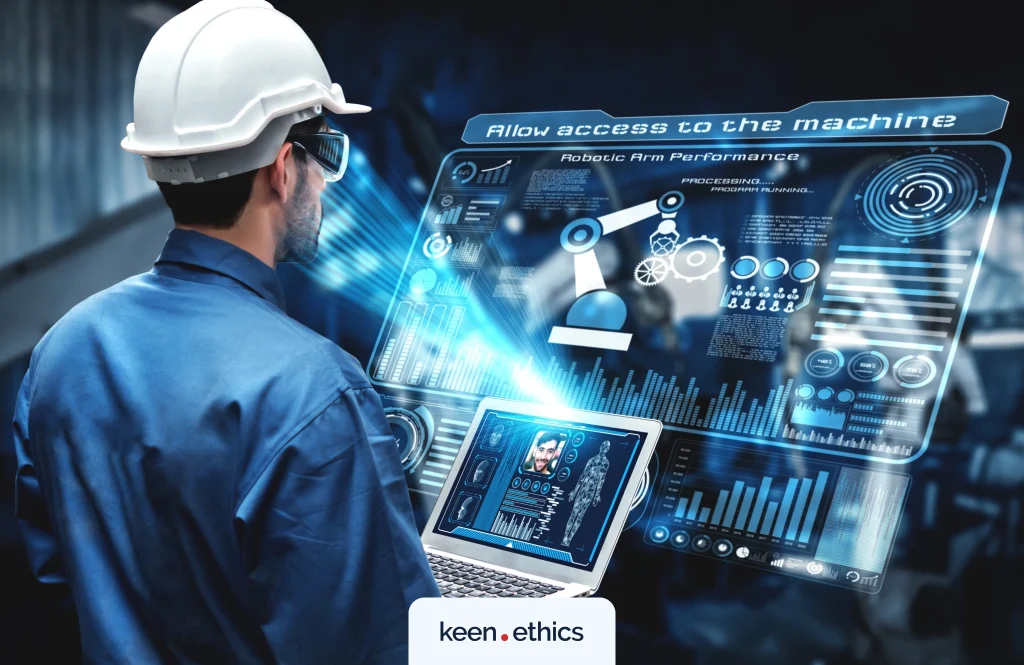
Modern software teams are expected to move fast, but maintenance pressure constantly pulls in the opposite direction. AI technologies address this by taking over the detection, classification, and resolution work that would otherwise consume developer hours. Here’s where it makes the biggest difference.
Bug Detection and Classification
Traditionally, bugs surface when users report them, which means the damage is already done. AI shifts this by continuously scanning code and system behavior, using algorithms to flag anomalies. When issues are found, it classifies them automatically by type, severity, and likely cause, cutting down triage time significantly.
As a result, developers spend less time hunting for problems and more time solving them. It’s no surprise that 78% of software testers now use AI tools to improve productivity.
Predictive Maintenance
If bug detection is about catching problems faster, predictive maintenance is about avoiding them altogether. AI does this by monitoring live system behavior against historical baselines using predictive analytics and machine learning.
That lead time gives teams room to:
- Schedule fixes during low-traffic windows.
- Patch vulnerabilities before they’re exploited.
- Plan maintenance around the business calendar.
It’s the difference between managing your software and being managed by it.
Support Ticket Resolution
Support queues grow faster than teams can handle them. AI reduces this pressure by categorizing incoming tickets, routing them to the right person, and resolving common issues automatically. The more tickets it processes, the more accurate it becomes at recognizing patterns and suggesting resolutions.
Teams still handle complex or sensitive cases directly, but the volume of repetitive requests that actually reach a developer drops. In practice, companies using AI resolve tickets in an average of 32 minutes, compared to up to 36 hours without it.
Automated Code Monitoring, Analysis, and Refactoring
As software scales, so does technical debt. Performance gradually degrades, and every new update carries a higher risk of introducing regressions. AI addresses this by continuously monitoring code health and surfacing risks before they compound.
This includes:
- Identifying redundant or inefficient code.
- Detecting security vulnerabilities early.
- Recommending or applying refactoring improvements.
- Enforcing consistent coding standards across the team.
Documentation and Knowledge Management
Documentation is one of those things every team knows matters, but rarely has time to keep up with. As systems evolve, it falls out of date, knowledge gets siloed, and onboarding new team members becomes harder than it should be.
AI can generate documentation directly from code changes, update knowledge bases as systems evolve, and flag outdated content before it causes confusion. More so, when team members need information, it surfaces the right data and insights quickly.
Key Benefits of AI in Software Maintenance
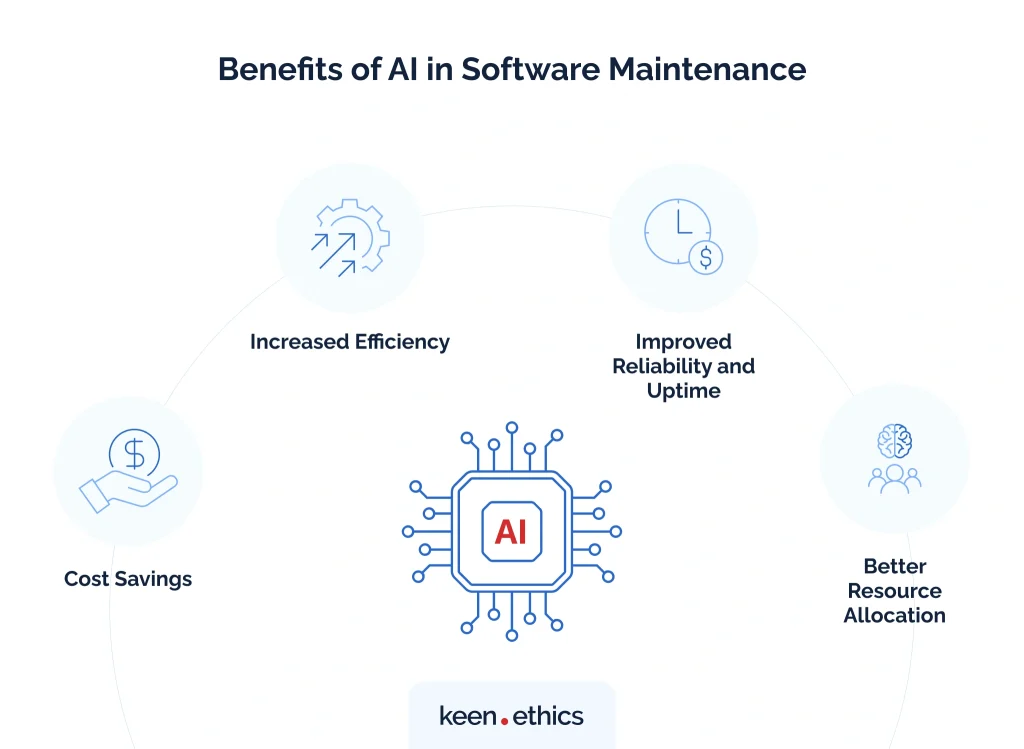
Beyond simplifying day-to-day work, AI also changes the outcomes teams can achieve, leading to a more efficient use of time, resources, and overall maintenance efforts. To better understand this impact, let’s take a closer look at the four benefits that matter most to operations and leadership.
Increased Efficiency
Maintenance work is full of tasks that are necessary but don’t require human judgment. With AI, teams can automate log reviews, code checks, ticket sorting, and routine monitoring, freeing engineers for higher-value work. There are even studies showing that AI tools reduce code review cycle time by over 30% and significantly accelerate development workflows. Teams get more done without adding headcount.
Improved Reliability and Uptime
From a business perspective, unplanned downtime is expensive and often preventable. AI reduces it by continuously monitoring system behavior and detecting early signs of degradation. One research confirms that AI-driven maintenance can increase uptime by 10–20% and reduce unexpected breakdowns by up to 70%. This translates into fewer outages, more predictable operations, and less time spent in crisis mode.
Cost Savings
Switching to predictive maintenance is one of the highest-ROI moves a team can make. Problems caught early cost a fraction of what they do in a crisis, and unplanned downtime tends to be far more expensive than most maintenance budgets account for.
According to public papers, the numbers make a strong case:
- Maintenance costs drop by 18–25% with AI tooling in place.
- Predictive approaches deliver up to 40% savings compared to reactive strategies.
- Organizations report overall cost reductions of 25–30% by eliminating unnecessary repairs.
Better Resource Allocation
When engineers spend most of their time on routine maintenance, there’s little left for work that drives the business forward. AI balances this by automating repetitive tasks and surfacing only issues that need human attention. Teams can plan maintenance around impact and urgency, not whatever happens to surface first. The practical outcome is more strategic decision-making and less need to scale the team.
Challenges of AI in Software Maintenance
Like any meaningful shift in how a business operates, getting AI software maintenance right takes more than just deploying a tool. Before the benefits kick in, most teams will encounter at least a few of the following challenges. The good news is that none of them are insurmountable.
Accuracy and Trust
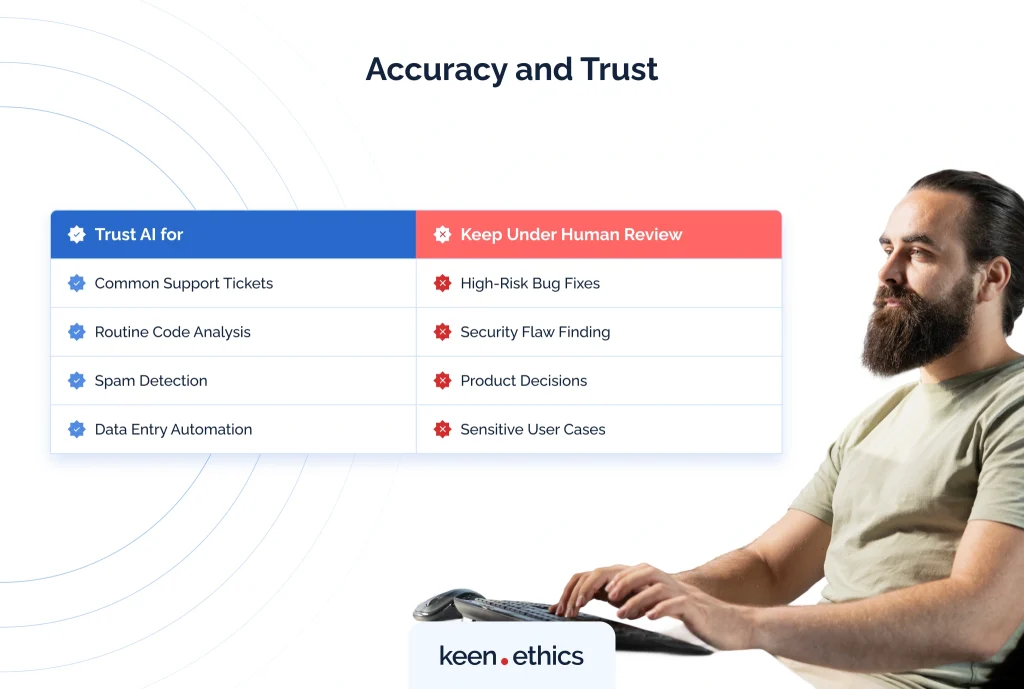
AI systems are not perfect. They can misclassify bugs, miss edge cases, or generate suggestions that seem correct but introduce subtle issues later on. And yet teams often adopt these tools faster than trust in their outputs can fully develop.
For business owners, this gap matters. Decisions based on inaccurate AI outputs can lead to costly errors and, unlike human mistakes, they can be harder to detect and trace. While modern AI models continue to improve in accuracy, they still depend heavily on the quality of data and training they receive. The best approach is to let AI handle high-volume, lower-risk tasks but keep critical decisions under human review.
Lack of Transparency
If you’ve ever worked with AI tools, you’ve probably noticed that many of them can’t fully explain how they reached a conclusion. A model might flag a piece of code as high-risk or automatically close a support ticket, but if no one can see the reasoning behind that decision, it’s hard to know when to trust it and when to question it.
This is especially problematic in regulated environments, where decisions need to be auditable and traceable. If an AI recommendation causes an issue and you can’t reconstruct why it was made, accountability quickly becomes a concern. While modern AI tools are improving in this area, full explainability is still not always guaranteed.
Integration with Legacy Systems
One of the biggest barriers to AI adoption lies in what it needs to connect to. As AI became more mainstream around 2023, many old legacy systems were not designed to support it, making integration more complex than it initially appears.
The core issue is usually data. AI needs clean, structured, and accessible information to function well and legacy environments often can’t provide that without meaningful upfront work. The most realistic path forward is to start with targeted integrations and modernize in phases, rather than attempting a full infrastructure overhaul from day one.
Security and Compliance Risks
As AI handles more sensitive data and automates more decisions, the security stakes rise accordingly. Many businesses are still treating AI as a low-governance area, which creates real exposure, particularly around data access and model behavior.
The compliance landscape is also shifting quickly, with AI-specific regulations emerging across most major markets. Businesses that haven’t established formal governance frameworks are already playing catch-up. To mitigate these risks, treat AI security as part of the rollout strategy from the very beginning.
5 Steps to Implementing AI in Software Maintenance
Implementation of AI in software maintenance doesn’t have to mean a massive, disruptive overhaul. The teams that get the most out of it usually start small, move deliberately, and build confidence before scaling. Here’s a practical way to approach it.
Step 1: Audit Your Current Maintenance Workflows
Before introducing any new technology, it’s worth getting an honest picture of how things work today. Where does time actually go? Where do issues tend to pile up? Which parts of your maintenance process feel the most unpredictable or expensive? The goal is to identify two or three areas where the current workflow is inefficient or fragile. Those become your entry points.
Step 2: Identify the Highest-Impact Use Cases
With a clear picture of your pain points, the next step is matching them to what AI actually does well. At this stage, don’t try to automate everything at once. Focus on tasks where the volume is high and the work is repetitive: ticket classification, anomaly detection, code scanning, and documentation generation. Starting here builds internal confidence and gives you real data to evaluate before expanding the scope.
Step 3: Choose the Right Tools and Partners
The AI tooling landscape is crowded, and it’s easy to get pulled toward whatever is generating the most buzz. What matters more is how well a tool fits your needs. This is also the step where many businesses benefit from working with an experienced partner. At Keenethics, for example, our software maintenance process is built around helping teams make these decisions in the context of their actual systems.
Step 4: Run a Pilot Before Full Rollout
Resist the urge to go all-in immediately. A focused pilot with one team, one workflow, and one tool creates a controlled environment where you can learn what works, catch integration issues early, and measure impact before committing at scale. In our experience, it helps to define what success looks like for your business and evaluate results after 30 to 60 days to understand the actual effect.
Step 5: Monitor, Measure, and Iterate
Once your tools are live, the work shifts to monitoring performance, collecting feedback from the people using them, and refining the setup over time. Of course, the initial deployment is important, but long-term value comes from continuous improvement. AI systems evolve with usage, so the goal is to keep them aligned with your team’s needs.
The Future of AI Software Maintenance
The way AI is used in maintenance solutions today already represents a meaningful shift from where things stood just a few years ago. But in many ways, we’re still in the early chapters, and the direction things are heading matters for any business thinking beyond the next quarter.
The most significant change on the horizon is how AI participates in the work itself. Right now, most systems support human decisions by flagging issues, surfacing patterns, and suggesting fixes. What’s coming is AI that can act on those insights as well, with a human in the loop only at the moments that require judgment.
Adoption is also accelerating in ways that will create a visible gap between businesses that have built the right foundations and those that haven’t. Clean data, integrated systems, and well-defined workflows determine whether AI delivers real results. The businesses putting this groundwork in place now will have a clear advantage over those waiting for the technology to feel more certain.
Our take at Keenethics is that the biggest opportunity for businesses lies in making better use of what AI can already do. The companies that benefit most in the coming years won’t necessarily be the ones with the advanced tools. They’ll be the ones that have built the right processes and partnerships to use what they have well.
Software Maintenance Support Services by Keenethics
Good software doesn’t stay good on its own. It requires consistent attention to keep performing the way your business depends on it. That’s why many companies turn to experienced partners to support their maintenance efforts before something goes wrong. The Keenethics team is one of them.
Software maintenance support is a core part of what we do. We work with businesses to help their products stay stable, secure, and aligned with where they’re headed. In practice, this looks different for every client. Some look for ongoing technical support, others are dealing with accumulated improvements, while some need a dedicated specialist who knows their product and is available when it matters.
What ties all of this together is a structured process. We take time to understand your goals, review the project, and build a proposal that reflects your situation. If you’re exploring how AI can fit into your maintenance tasks, that conversation starts here. We take care of implementing AI in software maintenance where it makes sense.
Final Thoughts
As you can see, AI and machine learning models are already reshaping how software maintenance is done, and many businesses are looking for ways to adopt it. If you’re on the same path, the most important advice from us is to focus on automating the right problems and build around them step by step. AI agents are unlikely to replace human judgment, but it will change where and how that judgment is applied.
Keenethics has delivered software maintenance services for over 10 years. We help you streamline maintenance processes, align your software with current industry standards, and identify security vulnerabilities before they become problems.

FAQ
How does AI change the traditional software maintenance and support services process?
AI shifts the traditional software maintenance process from a reactive model to a more proactive one. Instead of waiting for issues to appear, teams can use AI-driven systems to monitor performance, detect anomalies, and address problems early. This reduces the need for constant manual intervention and allows teams to focus on higher-value work.
How does AI-driven software maintenance reduce costs for businesses?
AI reduces costs by preventing issues before they escalate and minimizing the need for expensive emergency fixes. Through predictive maintenance and analytics, teams can identify risks early and resolve them at a lower cost. Over time, this leads to reduced maintenance costs, fewer disruptions, and more efficient use of resources.
How do software maintenance support services benefit from AI integration?
AI enhances software support by automating repetitive tasks such as ticket classification, monitoring, and documentation. It helps teams process large volumes of requests more efficiently and provides actionable data and insights for better decision-making. As a result, support services become more responsive, consistent, and scalable as systems grow.
Can AI software support help improve overall software performance?
Yes, AI can significantly improve performance by continuously monitoring system behavior and identifying inefficiencies. Relying on AI algorithms, it can detect patterns that indicate potential slowdowns or failures. This allows teams to optimize performance proactively, especially in large-scale systems, where manual monitoring would be difficult to maintain.
What is preventative software maintenance and why is it important?
Preventive maintenance focuses on identifying and addressing potential issues before they cause failures. With the help of AI, this approach becomes more effective through continuous monitoring, predictive analytics, and automated responses. It helps reduce downtime, improve system reliability, and ensure that maintenance activities are aligned with long-term business goals.