Web Development
 Mobile Development
 AI & ML Development
 Low-Code/No-Code Development
 React.js
 Vue.js
 Node.js
 Bubble
 Corporate Training Software Development
 Custom Real Estate Software Development
 Custom B2B Ecommerce Development
 Non-Profit Software Development
 About Us
 Team
Team Career





Some partnerships start with a grand plan. The one between Keenethics and Oleksandr Khotemskyi, a Ukrainian software testing expert, started with a simple question: what if we could build something that actually matters for QA engineers?
What followed was a year of collaboration, experimentation, and iteration. Somewhere along the way, that question took shape as a real solution, CyborgTests, which DOU later named as one of the most promising startups of 2026.
This is the story of how it all came together.
Our Search for Expertise Led to an Unexpected Partnership
It started, as many good things do, with a problem of our own. Keenethics was exploring the idea of building a testing tool. We had a promising concept, but promising concepts need validation. And validation, more often than not, needs the right people in the room.
So we went looking for ways we could test assumptions and someone with real domain expertise. That search led us to Oleksandr Khotemskyi, a Ukrainian QA engineer who had already been quietly building a product named CyborgTests.
CyborgTests Explained
By the time we found Oleksandr, his project, CyborgTests, was already live as an open-source tool on GitHub. The idea behind it was a product that could help QA engineers automate testing, but without the need to automate everything.
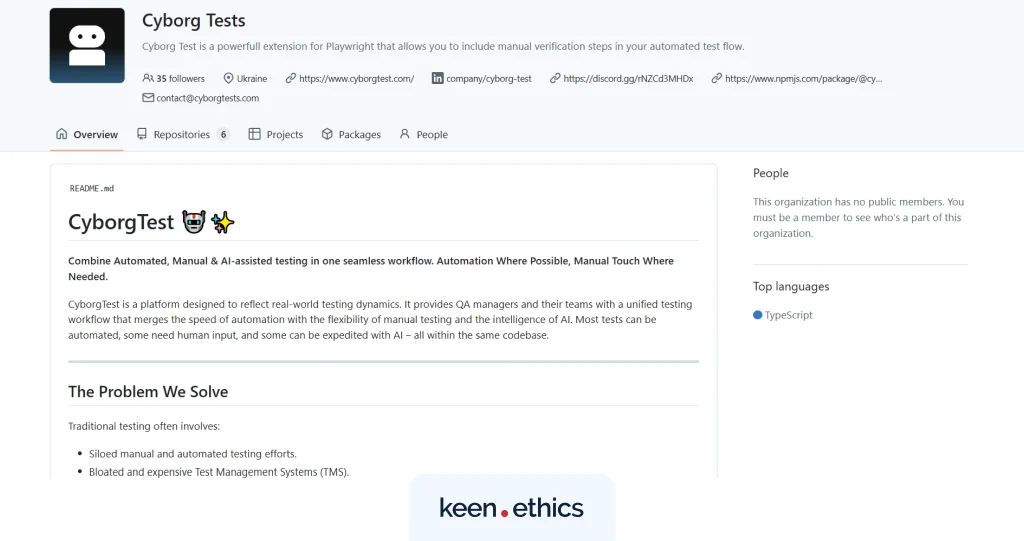
In simple terms, scripted testing works beautifully… until it doesn’t. There are always steps in a testing flow that are nearly impossible to cover automatically, like CAPTCHA. You can handle the entire login flow without human input, but once you hit that point, the process breaks down.
CyborgTests offers a different approach. Instead of choosing between full automation and fully manual testing, it allows you to combine both within a single flow. You can pause an automated test at a tricky step, hand control over to a human tester, and then resume automation once that step is completed.
It’s a conceptual shift that gave us a shared foundation, and a reason to start building together.
What Keenethics Actually Did for CyborgTests
CyborgTests was already built. Oleksandr had the vision, the code, and real experience running it inside his own QA team. What it didn’t have yet was an audience. That’s where Keenethics came in with two founders, a product manager, a design lead, and a developer, all aligned on making CyborgTests visible to the world.
Product packaging
The first thing we tackled was visibility. CyborgTests already existed on GitHub, but a GitHub repository, no matter how well-built, isn’t a product. It’s a codebase. And codebases don’t convert visitors into believers.
So we built a landing page. Designed and deployed entirely by the Keenethics team, it became the public face of CyborgTests, the place where the tool’s concept could be communicated clearly, visually, and compellingly. We also reworked the GitHub project presentation itself, adding visuals and GIFs that made the repository feel approachable.
The result was a product that looked like one. And that landing page ended up being the very page DOU later linked to when awarding CyborgTests.
Marketing validation
Having a product that looked the part was only the first step. The next question we stumbled across was harder: did anyone actually need it?
To find out, we built a funnel. It started with paid campaigns across Instagram and Google Ads, where we mixed video and creatives designed to reach QA engineers and testing professionals. Over 3 months, we ran 3 campaigns with a total spend of around $1,000, reaching 4,000 users across both platforms.
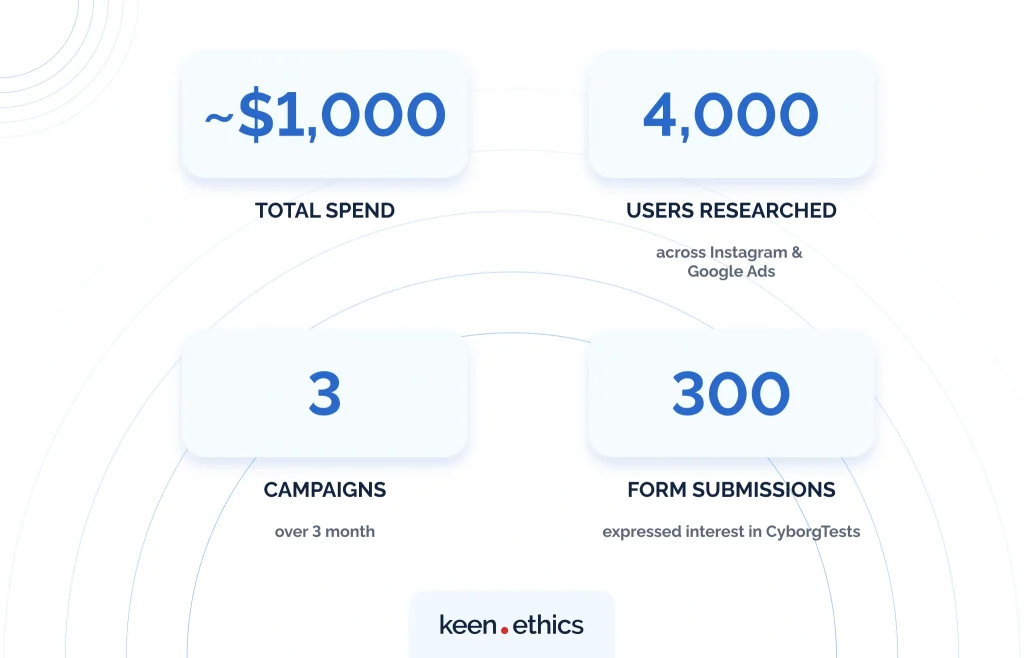
Anyone who clicked landed on the CyborgTests landing page, where a simple form invited them to share their interest. 300 people in total filled it out.
We wanted to understand who was paying attention, why they cared, and whether the problem CyborgTests solved was painful enough to matter. The campaigns ran, the form collected responses, and the funnel brought in the right people to talk to.
User Research
With the funnel running and conversations happening, we started picking up on patterns. We conducted in-depth interviews with QA professionals who had shown interest in CyborgTests, and what we heard shaped almost every decision that followed.
The clearest signal we’ve got is that people didn’t fully understand what CyborgTests was for. Not because the product was weak, but because we hadn’t communicated it clearly enough. That insight alone drove a wave of changes to the landing page:
- Hero section rework — we refined the positioning to communicate the product’s value, adding a gif of the app UI so visitors could see what they were getting into.
- Clearer product explanation — we added information about how CyborgTests works, positioning it as a tool for manual testers, with no coding required.
- Video from Oleksandr — instead of a generic demo, we asked Oleksandr to record a walkthrough himself, adding a human face to the product.
- Light theme — dark felt right at first, but users associated it with GitHub and developer tools, so we switched to a lighter, more neutral look.
- Social credibility — we added testimonials so that first-time visitors could immediately feel this was something trustworthy and battle-tested.
Continuous feedback loop
Those interviews weren’t a one-off exercise. At Keenethics, we value iteration based on continuous feedback, and throughout our collaboration with Oleksandr, that’s exactly how we worked.
Every insight gathered from the campaigns, every conversation with a potential user, fed back into the product. We’d talk to Oleksandr, realign, adjust, and go again. What made this work was the nature of the partnership itself. Because Oleksandr was actively running CyborgTests within his own QA team, real-world feedback was never far away. He didn’t have to imagine how users would react. He was one of them.
On our side, the Keenethics team stayed close throughout by checking in, stress-testing assumptions, and making sure the direction stayed grounded in actual user needs. Of course, the process wasn’t always fast. But it was always honest. And that, more than anything, is what kept CyborgTests moving forward.
The Way CyborgTests Got Recognized by DOU
Oleksandr believed in what he had built and decided to put CyborgTests in front of one of Ukraine’s most respected tech communities, applying to the DOU awards himself.
By that point, the product had a clear identity, a landing page that communicated it well, and a real user base. Oleksandr’s own team had fully adopted CyborgTests, abandoning their previous tools in favor of it. And the numbers were growing: within just the last 3 months, nearly 400 people had launched the app over 2,500 times.
When the nomination was announced, the collaboration briefly shifted back into an active phase. Keenethics promoted CyborgTests across our own channels, rallied our network to vote, and made sure the story of what CyborgTests was — and what it could become — reached as many people as possible. We held internal tech talks about the product, shared it widely, and advocated for it the same way we had from day one.
DOU recognized CyborgTests as one of the most promising startups of 2026. Not the loudest, not the biggest, but one with a concept strong enough to stand out: the idea that manual and automated testing don’t have to live in separate worlds.

Let Keenethics help you build, validate, and launch a product that stands out.